Decoding Brain Injury
Research & Inquiry
Using the latest technology, Smith College professor Ingo Helmich is unlocking the secrets of sports concussions

Photos by Jessica Scranton
Published June 8, 2026
Detecting head injuries is not an exact science—yet. Traumatic brain injuries (TBIs)—a catch-all term for head trauma, including concussions—are notoriously tricky to diagnose. X-rays show broken bones; CT scans sometimes reveal bleeding, but a concussion leaves no visible mark. The damage is functional, not structural, and that distinction has made it one of the most difficult injuries in sports medicine to diagnose. Symptoms reported by patients are the most common means to base a diagnosis, and these can be delayed for days. Internal bleeding or swelling can occur without visible changes, and long-term complications can result from a seemingly mild injury.
Ingo Helmich, director of the Motor Neuroscience and Neuroimaging Laboratory (MNN Lab) and a motor neuroscientist and movement scientist who joined Smith College’s exercise and sport studies (ESS) department in 2024, is working to change that. His focus is on improving diagnostics for sport-related concussions. His research is grounded in human movement neuroscience, and his work explores the intersection of motor cognition, neuropsychology, and neurology.
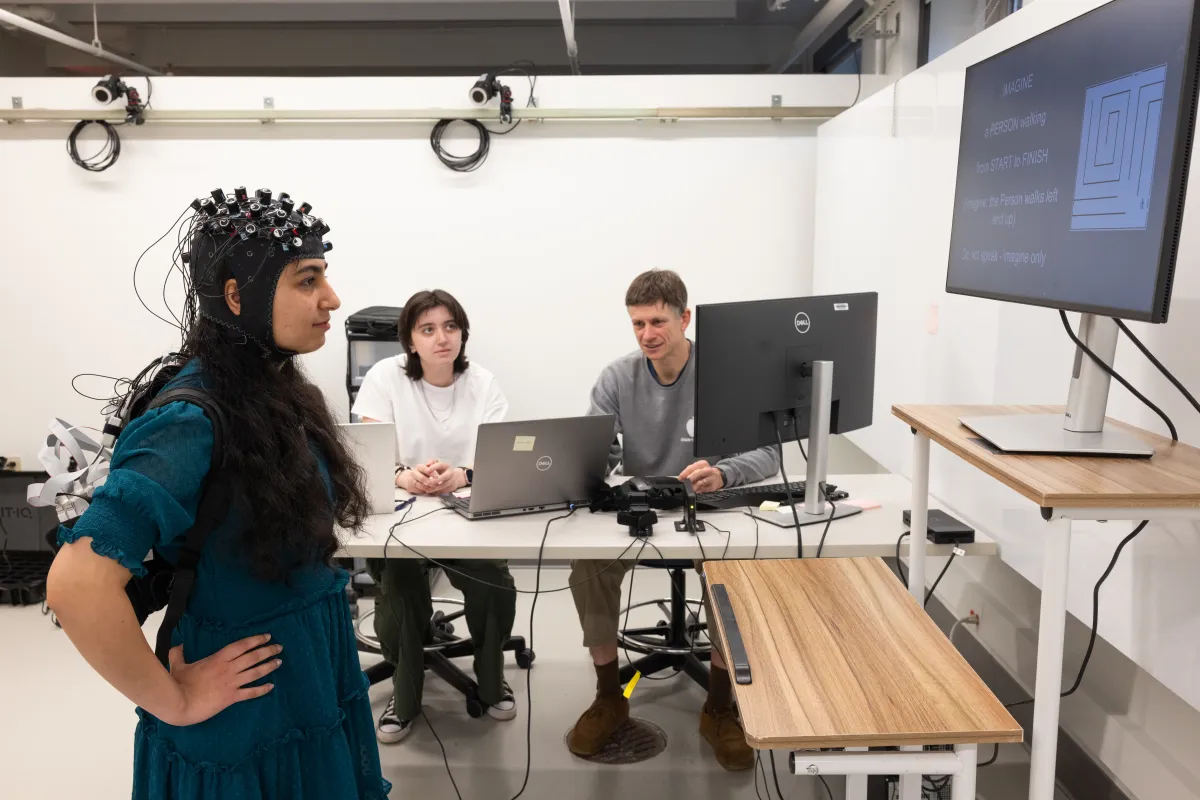
Currently, he is working with Smith’s rugby team. First, Helmich gets a baseline reading of each player’s movements, balance, and brain function using functional near-infrared spectroscopy (fNIRS). Each player dons a lightweight cap embedded with sensors that measure brain activity while the player moves freely. Unlike an MRI, which requires the subject to lie still in a large scanner, fNIRS goes where the athlete goes. Paired with cameras and motion-capture equipment that track every step and shift in balance, the fNIRS allows observation of brain function and movement at the same time. “Concussion is often characterized by postural deficits,” Helmich explains. “So, I use movement science and brain science together to get a better understanding of post-concussion deficits.”
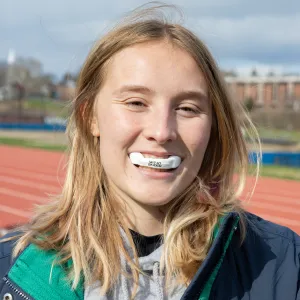
The second part of the study takes place on the field. During games and practices, each rugby player wears a mouthguard embedded with sensors that record head acceleration and impact in real time. The data is downloaded afterward, much like footage from a camera. Now, Helmich has an objective record of what has happened to a player’s head during a game—no self-reports involved. If a player registers a significant hit, they are called back into the lab, and the post-impact data is compared with the baseline data. Instead of relying on self-reported symptoms, the mouthguard sensors provide much more information, such as the location of the injury and crash velocity.
Helmich cites a recent case study as significant: One player who had already suffered two concussions before the season experienced a third in late March, and reported symptoms, including headaches. Despite this, the follow-up testing showed altered brain functions paired with minor behavioral improvements—their cognitive score ticked up slightly and their balance control was better than their baseline. This student-athlete stopped playing sports after the March injury.
While the student’s performance scores looked fine, their brain activation patterns after the concussion looked markedly different from their pre-season baseline— suggesting their brain was using significantly more cognitive effort to achieve similar results. “This showed that after the potential concussion, the student’s brain works differently than before for the same performance,” says Helmich. “We will now compare this data in a bigger sample to understand whether such neurobehavioral results are significant.”
The long-term effects of repeated sub-concussive impacts—like the headers common in soccer—remain hotly debated. Helmich believes more sensitive, real-time data could eventually help coaches and medical staff make better decisions about when and for how long a player should rest.
Helmich’s research plans are substantial. He hopes to include players from a variety of sports and from other schools in the area, including men’s teams, then track research participants over five to ten years. “The bigger differences will show up in someone who has had many head impacts over several seasons,” he theorizes.
A native of Germany, Helmich earned his Ph.D. in sports science from German Sport University Cologne in the department of neurology, psychosomatic medicine, and psychiatry. He completed postdoc studies at the Montreal Neurological Institute at McGill University in Montreal and his habilitation at the German Sport University Cologne. An accomplished movement therapist, he was an assistant professor in motor behavior in sports at the German Sport University Cologne, where he also conducted concussion research, before coming to Smith.
Students here are central to his work. In addition to studying student-athletes, they serve as lab assistants and run assessments, analyze data, and contribute ideas that, Helmich says, have genuinely shaped the research. “Smith students are very creative,” he says. “I benefit from their ideas so much.”