Smith College and the Upside Down: The Surprising ‘Stranger Things’ Connection
News of Note

Published December 19, 2025
NOTE: The Smith College T-shirt worn by the character Robin Buckley is now available through a Smith pop-up store. Order yours before January 31. Shipping begins in mid-February.
Spoiler alert: This story contains details from season 5 of Stranger Things.
More than 60 years after A Wrinkle in Time whisked readers through time and across galaxies, Smith College alum Madeleine L’Engle ’41’s classic tale is trending once again thanks to a group of teens from the fictional town of Hawkins, Indiana, and a scary place called the Upside Down. The beloved novel makes a crucial cameo in the latest season of Netflix’s wildly popular series Stranger Things, perhaps offering clues to the show’s biggest mysteries as it barrels toward its finale on New Year’s Eve.
L’Engle’s sci-fi adventure, originally published in 1962, follows Meg Murry, Charles Wallace Murry, and Calvin O’Keefe as they hop from one galaxy to another on their quest to rescue the Murrys’s father from an evil force known as The Black Thing. Stranger Things follows a group of friends as they attempt to save various loved ones from the clutches of monsters known as Demogorgon, Mind Flayer, and Vecna who inhabit the Upside Down, a dark alternate universe. In episode 2 of season 5, one of the characters, Holly Wheeler, younger sister to main characters Nancy and Mike, is seen reading A Wrinkle in Time. After a Demogorgon snatches her from her parents’ house and imprisons her in the Upside Down, she draws on the lessons she’s learned from L’Engle’s story to survive and plan her escape—namely that love and believing in herself are the best defenses against evil.
Meanwhile, A Wrinkle in Time wasn't the only Smith-related reference in the show's closing chapter. In one of the final scenes, one of the main characters, Robin Buckley, was spotted wearing a vintage Smith College t-shirt featuring the iconic Grecourt Gates, hinting at the character's decision to move to Massachusetts and attend Smith College.
Elizabeth Myers, director of special collections at Smith, says it’s no surprise that A Wrinkle in Time is back in the public consciousness. “Part of L’Engle’s talent was to craft a book, ironically, that feels timeless,” Myers says. “The major themes of good versus evil, the universal power of love and relationships, are as inspiring as they are familiar.”
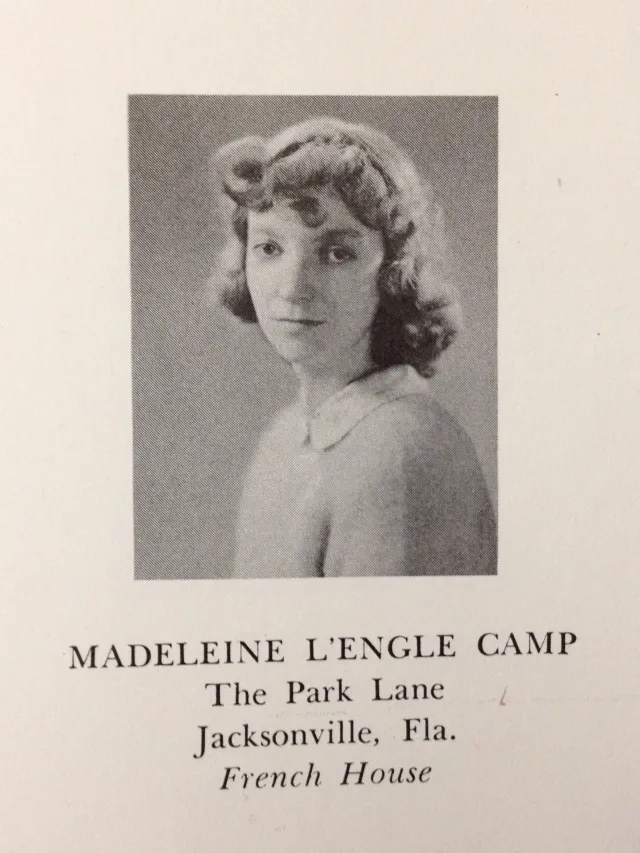
Smith acquired a large portion of L’Engle’s literary estate in 2018. Filling nearly 70 boxes and dozens of file folders, the collection is housed in the college’s special collections archive, one of the country’s leading repositories of rare books, manuscripts and other ephemera related primarily to women’s lives, accomplishments, and history. It contains drafts of early manuscripts; original editions of hundreds of literary magazines that L’Engle contributed to throughout her life; an extensive array of family letters; fan mail; postcards and photographs; materials from her time at Smith; and memorabilia from her writing room, including the National Humanities Medal she received in 2004 and the Smith College Medal she received in 1981.
Today, L’Engle’s collection is receiving extensive use, says Mariana Brandman, archivist in the Sophia Smith Collection. Archives staff have digitized more than 1,000 pages, which are available through the archive’s website, and researchers have requested material from L’Engle’s papers over 100 times in the past few years. Brandman says having L’Engle’s work is a particular point of pride for Smith, but not simply because the author is an alum. “L'Engle's commitment to her craft and her genre-bending literary talent left an indelible imprint on American literature, allowing generations of young women to see themselves represented in literature and inspiring them to pursue their own creative passions," Brandman says.
“Part of L’Engle’s talent was to craft a book, ironically, that feels timeless. The major themes of good versus evil, the universal power of love and relationships, are as inspiring as they are familiar.”
One of those young women was Andrea Hairston ’74, Smith’s Louise Wolff Kahn 1931 Professor Emerita of Theatre and award-winning author of numerous science fiction novels, including Archangels of Funk, Mindscape, and Will Do Magic For Small Change. For her, A Wrinkle in Time provided inspiration and sustenance at different moments in her life. She read it as a child who loved fantasy and thought that one day she’d grow up to be a physicist or mathematician. Then in college Hairston read the novel again for its “prose and brilliant metaphorical landscape that transported readers and encouraged us to find alternative possibilities in ourselves.” Today, as an author herself, she admires L’Engle’s craft and wisdom.
Hairston says the story endures because its message resonates with readers of any age. “A Wrinkle in Time has been good company for my life,” she says. “It presents readers with an urgent challenge: Make the world you want. Let no one define the extent or the range of your possibilities. Invent what you need and be who you mean to be.”
And, in the end, it’s only fitting that it be a Smithie who has held the secret to outwitting interdimensional monsters and righting the universe the entire time. After all, saving worlds—it’s just what Smithies do, right? Nothing strange about that.
Visual effects include motion and color shifts.